Welcome to Housing Tech News
This e-publication is exclusive CHBA Member content, providing you with updates on the efforts of the CHBA Technical Research Committee, including information on technical research, changes to code and standards, and related events and communications. If there is a colleague in your company or a fellow CHBA member who should be receiving this content, we'd like to help you share it. However, don't just forward this email—that allows other people to unsubscribe you. Instead, please email us with the person's name, company name, and email address and we'll create an account for them and then let them know.
|
In this issue:
- CHBA Calling for Pause on Canada’s Building Codes
- New 2025 National Model Codes Now Available for Download
- When will 2025 National Codes be adopted in my province?
- What’s new in the 2025 National Building Code?
- Where can I get more info on each of these changes?
- CHBA Part of Stakeholder Group Getting Affordability Recognized in Codes
- Lateral Loads: Simplifying 2025 Code Changes
|
CHBA Calling for Pause on Canada’s Building Codes
CHBA is calling for an immediate pause on changes to Canada’s national model building codes because the current approach is making new housing too expensive and harder to build. CHBA is actively coordinating with our provincial associations to have this message delivered to and through provincial governments. The proposed 2025 codes introduce a large number of new requirements without a clear and comprehensive assessment of their total cost or real‑world impact. CHBA estimates that these changes, coupled with higher energy tiers, could add more than $100,000 to the cost of a typical new home, at a time when affordability is already a major challenge for Canadians. But cost is not the only reason: CHBA members are also concerned that the code development process has become less transparent and less grounded in evidence, with less and less input from those who actually build homes. Without properly addressing affordability in building codes, provinces may not adopt the national codes and instead may continue to make their own changes, leading to less harmonization and more red tape. A pause would allow governments and industry to fix these problems and create codes that support both climate goals and the urgent need for real housing affordability and more supply. Canada is not alone in facing these challenges. In 2025, the Australian Government announced a pause on changes to its National Construction Code (NCC) until 2029. In its letter to the Prime Minister, CHBA has outlined its concerns and the call for the pause. CHBA is, of course, in contact through a variety of federal advocacy channels to push this action forward, which will be bolstered by the all-important coordinated effort coming simultaneously from provincial HBAs. For more information, please email Frank Lohmann.
|
New 2025 National Model Codes Now Available for Download
CHBA’s concerns with the 2025 code aside, the 2025 editions of the National Model Codes have officially been released and are now available for download at no cost. While CHBA was successful in getting some positive changes and preventing some negative ones, overall, the 2025 National Building Code remains problematic on many levels and as such, per above, CHBA is calling for a pause on adoption and is pushing for a re-write of some sections and elimination of others, based on affordability and other issues. That all said, interested members can download the 2025 National Model Codes and review the new requirements to maintain a competitive edge and/or to feed into the ongoing advocacy regarding challenges with the code. Each change is marked with a bar on the side of the page. Often the Explanatory Notes provide helpful guidance.
When will 2025 National Codes be adopted in my province?
Adoption timelines will vary by province and territory. Some adopt immediately, others allow 6–12 months before enforcement, and some take longer. All jurisdictions have committed to adopting their versions by mid-2027 (18 months after publication), though again, CHBA, along with the provincial HBAs, is pushing for a pause on codes or at least significant revisions before adoption, which would have a mid-2027 timeline as well. Note: Some provinces will modify codes before adoption. As always, follow announcements from your provincial building safety regulator.
Although the Canadian Board on Harmonized Construction Codes (CBHCC) maintains a web page with provincial adoption dates, there is currently no information available as to the provinces’ intentions of adopting the 2025 National Construction Codes. CHBA staff will keep members informed if new information becomes available. Please email Frank Lohmann for more information.
What’s new in the 2025 National Building Code?
The new edition of the National Building Code (NBC) includes significant technical changes that will impact residential construction if adopted. CHBA staff and members have participated in thousands of hours of committee meetings over the last three years with the goal of ensuring these changes are constructible and cost effective – sometimes with mixed success, as several changes remain problematic. For an overview of the technical changes in Part 9 of the 2025 NBC, CHBA has prepared a brief summary for members, including both potential issues and positive changes. CHBA will communicate with provincial HBAs regarding potentially problematic changes (e.g. GHGs, lateral loads, and protection from radon ingress).
Where can I get more info on each of these changes?
To help you navigate and understand code changes quickly and effectively, CHBA aims to publish one or two key resources for each subject throughout the coming year:
These resources are available in HTML and PDF (scroll to the bottom of the webpage for the PDF). You can access these documents anytime through the CHBA Member Knowledge Centre. These tools are part of CHBA’s ongoing commitment to provide practical, timely guidance to members. Please email Alex Bols for more information.
|
CHBA Part of Stakeholder Group Working to Get Affordability Recognized in Codes
A group of code stakeholders, led by CHBA, is working on ways to recognize housing affordability within the code process. The group is developing a paper that examines how affordability is recognized in laws and regulations in Canada and other countries. For example, several countries and US states anchor affordability in principles forcing their regulators to show that codes achieve the largest benefits for the least cost, some set a cost limit for all changes within a code, and some include the compliance cost to industry in their assessment (not only the materials and labour). CHBA’s political advocacy continues to push for affordability to be a core objective of the national codes and all standards that they reference. For more information, please email Frank Lohmann.
|
Lateral Loads: Simplifying 2025 Code Changes
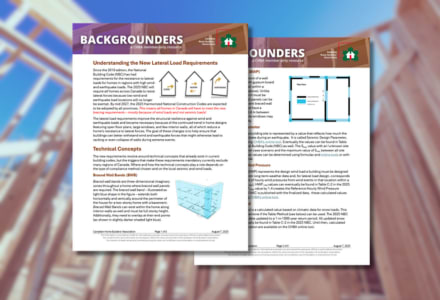
On a more technical side, CHBA has already engaged with governments and industry partners to improve the lateral loads requirements in the 2025 code, proposing to expand the newly published simplified path for lateral loads to make it more usable for typical Part 9 homes in low wind and low seismic areas. The current simplified method is too limited and only applies to very small homes with simple geometry (i.e. homes that are not very common), while the other compliance methods lead to unnecessary cost for engineering services. The collaboration develops clearer, more practical prescriptive solutions that reflect common home designs, are easier to build and enforce. CHBA is hoping that the change can be fast-tracked so that provinces can adopt it together with other hopefully other re-writes in a revised edition of the 2025 codes. If you wish to find out more about the 2025 changes for lateral loads and the limits of the simplified method, refer to our backgrounder on the subject. For more information, please email Frank Lohmann.
|
The Canadian Home Builders' Association
141 Laurier Avenue West, Suite 500
Ottawa, ON K1P 5J3
communications@chba.ca
|
|