Welcome to Housing Tech News
This e-publication is exclusive CHBA Member content, providing you with updates on the efforts of the CHBA Technical Research Committee, including information on technical research, changes to code and standards, and related events and communications. If there is a colleague in your company or a fellow CHBA member who should be receiving this content, we'd like to help you share it. However, don't just forward this email—that allows other people to unsubscribe you. Instead, please email us with the person's name, company name, and email address and we'll create an account for them and then let them know.
|
In this issue:
- Spring Economic Update Reflects CHBA Advocacy on Codes
- Future‑Focused, Builder‑Driven: TRC at Home Building Week
- CHBA Calls for Code Reform as Codes Canada Launches First 2030 Code Public Review
- Renovators: Take part in the Renovation Market Index (RMI), a new advocacy tool
- Builder Tested Resilience Checklists Now Available
- Managing Radon Risk: New Code Requirements and Practical Guidance
|
Spring Economic Update Reflects CHBA Advocacy on Codes
CHBA, working closely with our provincial home builders’ associations, has been very active in advocating on the lack of consideration for housing affordability in codes and many other challenges the National Building Code is creating for the industry and future homeowners (see “CHBA calls for Code Reform…” below). Against this backdrop, CHBA was pleased to see that Tuesday’s federal Spring Economic Update (the Update) included direction reflective of CHBA’s recommendations. While it does not yet include a full pause on code adoptions or new code development, it does include key direction to the National Research Council and the Standards Council of Canada. The Update commits $41.9M to “reduce regulatory friction, improve affordability, provide clearer and more predictable pathways for factory‑built housing, and shorten project timelines, and shorten project timelines.” This will include “strengthening analysis of proposed building code and standards changes to better assess the cumulative cost impact on housing affordability” – a major issue CHBA has been emphasizing with governments. These commitments are a positive step, and CHBA will continue pushing for further action to address the impacts of code on housing affordability and supply. CHBA is also pleased to see its recommendations for supporting factory-built construction being reflected in the Update, which commits to eliminating redundant factory and site inspections. CHBA will closely monitor when it comes to the proposed “performance-based approval pathway for modular and panelized systems.” CHBA is very pleased about the Update recognizing the need for action on “improving the consistency of how National Building Code requirements are interpreted.” This marks the first time that local interpretation differences are noted as a barrier. CHBA has several recommendations to address this, including a proposed national code interpretation centre. For more information, please contact Frank Lohmann.
|
Future‑Focused, Builder‑Driven: TRC at Home Building Week
The Technical Research Committee meetings taking place during CHBA’s Home Building Week in Quebec City will focus on the issues shaping residential construction over the next decade. Leading up to a behind‑the‑scenes window factory tour, the May 4 afternoon joint session with the Net Zero Council will explore how thin triple‑ and quad‑glazed windows affect thermal comfort, how fenestration innovations support wildfire resilience, and the role windows play in embodied carbon. On May 5, TRC turns squarely to building codes and real‑world energy decisions. The morning will highlight CHBA’s advocacy for a pause on codes, examining why housing affordability and market readiness must come first. A pan‑Canadian member roundtable will bring provincial perspectives on adoption challenges. TRC will also explore how builders can better engage utilities and make practical energy decisions as high‑performance homes drive lower, more variable energy demand. If you have not registered, you can do so here.
|
CHBA Calls for Code Reform as Codes Canada Launches First 2030 Code Public Review
While CHBA continues to advocate for a course correction to Canada’s national code development system, the Canadian Board for Harmonized Construction Codes opened the first public review for proposed changes toward the 2030 National Model Codes on April 27. The public review will run until June 22, and invites industry, regulators, and other stakeholders to comment on the first 14 draft technical changes covering the areas of accessibility, energy efficiency, plumbing, and off-site construction. Public review is a critical checkpoint, allowing technical input to be considered before code proposals advance toward approval and publication. CHBA’s technical staff will review the proposed changes and prepare comments ensuring member perspectives are reflected. CHBA staff will also recommend to codes committees that the criteria CHBA has developed in its recently published White Paper and Policy Position on Code Changes (login required) are adhered to for future code changes. For more information, please contact Frank Lohmann.
|
Builder-Tested Resilience Checklists Now Available
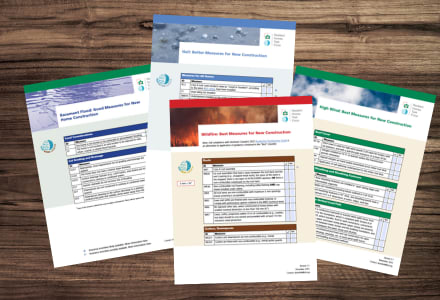
The Resilient Homes Task Force (RHTF) – a collaboration between the Institute for Catastrophic Loss Reduction and the Canadian Home Builders’ Association – has published a new set of practical resilience checklists for residential construction. Developed over the past two years, the checklists were refined through builder‑led field trials with CHBA members to ensure they are constructible, clearly prioritized, and aligned with real on‑site practices. CHBA member feedback also highlighted supply chain challenges for resilience-related products. The published checklists provide a clear, tiered approach (Good, Better, Best) to voluntarily improving resilience to hazards such as flooding, hail, high wind, and wildfire. CHBA and ICLR will continue this work over the next five years, focusing on increasing recognition of the checklists, educating consumers, encouraging product manufacturer to offer resilient products and the associated training for builders and renovators. The RHTF will also create opportunities for insurance-led field trials to test incentives linked to the checklists. For more information, please contact Bilal El-Zaylaa.
|
Managing Radon Risk: New Code Requirements and Practical Guidance
Last year, CHBA published a Radon Tech Essential explaining the basic concepts builders and renovators need to know when it comes to radon ingress into homes. We have now added a Radon Backgrounder that builds on that foundation, with more detail on upcoming 2025 National Building Code (NBC) requirements, what is changing from past codes, and feedback from radon mitigation contractors on how to avoid commonly encountered issues. It also includes information for mitigation strategies currently not included in the 2025 NBC. The backgrounder links to key standards, research findings, and technical resources to support implementation. The CHBA Member Knowledge Centre also provides a link to download a PDF of the Radon Backgrounder. Please provide and feedback on these documents and/or let us know what other resources you would like to help you in your business by contacting Jack Mantyla.
|
The Canadian Home Builders' Association
141 Laurier Avenue West, Suite 500
Ottawa, ON K1P 5J3
communications@chba.ca
|
|