Welcome to Building Modular News
This e-publication is exclusive CHBA Member content, which will be of interest to those directly engaged in modular construction as well as those looking to add modular or other factory-built elements to their offerings. Interested in learning more or getting involved with factory-built? Check out CHBA’s modular webinar series and follow the Modular Construction Council’s activities.
If there is a colleague in your company or a fellow CHBA member who might find this content interesting, we'd like to help you share it. However, don't just forward this email – that allows other people to unsubscribe you. Instead, please email us with the person's name, company name, and email address and we'll create an account for them and then let them know.
|
In this issue:
- What’s on the Agenda at the Next Modular Construction Council Meeting
- Codes Public Review: Proposed Change to CSA A277 to Improve Jurisdictional Consistency
- CHBA Advancing In-Factory Airtightness Testing with NRC
- ICYMI – Building Excellence Magazine – Focus on Modular Construction
- Task Group Concludes Many Barriers to Modular Construction Fall Outside Building Codes
- Recap - Funding Opportunities for Modular Factories
|
What’s on the Agenda at the Next Modular Construction Council Meeting
MAY 5, 2026 | QUEBEC CITY
The Modular Construction Council meeting will take place during CHBA’s Home Building Week, bringing together members for a focused discussion on the growing role of factory‑built construction in Canada’s residential construction industry. The agenda will spotlight dialogue on how the industry can address barriers to modular construction, including regulatory, technical, and market challenges, while looking at real‑world examples of successful collaboration between site‑builders and modular factories. Members will also discuss updates on codes, standards, CHBA technical activities, and innovation initiatives aimed at improving productivity.
|
Codes Public Review: Proposed Change to CSA A277 to Improve Jurisdictional Consistency
REVIEW OPENING SOON
CHBA technical staff have been actively engaged in the development of the next round of proposed code changes, advocating for clearer and more consistent treatment of modular construction across Canada. CHBA has emphasized reducing unnecessary re‑inspection of certified in‑factory work and strengthening recognition of CSA A277 as a credible compliance pathway for off‑site construction. A positive development has come from this work: there is a proposed change that proposes to move CSA A277 to an enforceable administrative provision of the National Building Code. The move would improve consistency across jurisdictions and eliminate duplication of inspection by clarifying that CSA A277 certification proves the required off‑site construction inspections have been completed, reserving on‑site inspections for site‑specific work such as foundations and module connections. CHBA will be submitting a public review comment and encourages modular members to review PCF 2157, which contains the proposed change, on CBHCC's website once it’s available to the public. Members can connect with CHBA to coordinate or submit comments on their behalf. For more information, please contact Alex Bols.
|
CHBA Advancing In-Factory Airtightness Testing with NRC
CHBA is working with the National Research Council (NRC) on a national research project aimed at addressing a long-standing regulatory barrier for modular and manufactured housing: the requirement to conduct airtightness testing on site, even when a blower door test has already been completed in a factory certified to CSA A277. The project is now moving into the data collection phase. Through this work, CHBA is coordinating a multi-manufacturer testing program across different regions of the country, working directly with CHBA member modular factories. Factory-built homes will be tested in the factory and again after delivery and installation to determine whether transportation and placement materially affect airtightness performance. Permitting in-factory airtightness testing aligns with how off-site construction is intended to function, with quality control, verification, and corrective action occurring in a controlled manufacturing environment. This approach has the potential to reduce costs, improve scheduling certainty, and restore productivity benefits currently lost due to mandatory on-site testing. The findings will support CHBA’s ongoing code advocacy and be shared with Codes Canada and relevant code committees, where the data will complement an ongoing proposed code change intended to enable this approach within the National Building Code.
|
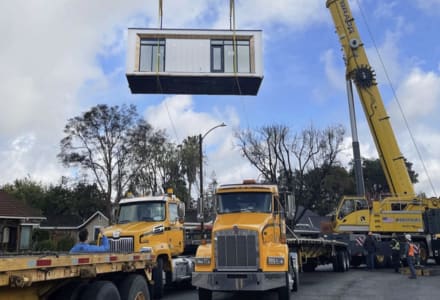
Image provided by Triple M Housing Ltd.
|
Task Group Concludes Many Barriers to Modular Construction Fall Outside Building Codes
The Task Group on Modular Construction, of which CHBA is an active member, is using direct industry input to examine whether barriers facing modular construction can be addressed through changes to the National Building Code (NBC). One of the task group’s key conclusions is that many of the most significant barriers are not strictly technical code issues. Challenges such as permitting practices, construction financing, limited familiarity with modular construction among Authorities Having Jurisdiction, and inconsistent regulatory application are often rooted in policy, administrative processes, or market structures rather than deficiencies in the NBC itself. As a result, these issues fall outside the formal mandate of the Task Group and the NBC code development process. Recognizing this, CHBA is pursuing a broader, coordinated strategy. In addition to its role on the Task Group, CHBA has been engaging directly with organizations such as CMHC to address non-code barriers, particularly construction financing and awareness of modular construction realities. This approach helps ensure progress is supported both within and beyond the NBC. CHBA will be continuing to tackle these barriers moving forward.
|
Recap: Funding Opportunities for Modular Factories
As part of its ongoing support for modular builders and manufacturers, CHBA recently highlighted two federal initiatives that present timely opportunities for modular factories, both focused on scaling housing delivery using Modern Methods of Construction (MMC). The first was Build Canada Homes’ (BCH) Request for Information on Modern Methods of Construction. This RFI was intended to inform how the federal government may deliver housing at scale and how MMC suppliers could be engaged in future federal projects. For modular factories, participation offered early visibility within the federal housing ecosystem and the opportunity to help shape future procurement pathways, such as a Request for Supply Arrangement. BCH noted that responses may be used to establish an interim directory of Canadian MMC suppliers. The second opportunity is Natural Resources Canada’s Green Construction through Wood (GCWood) Multi-Unit Residential Building Demonstration Program. This program is well aligned with volumetric modular and prefabricated systems and can fund up to 50 percent of eligible project costs, to a maximum of five million dollars. Together, these initiatives signal growing federal action in support of modular capacity and scalable delivery models—all in line with recommendations from CHBA’s Sector Transition Strategy.
|
The Canadian Home Builders' Association
141 Laurier Avenue West, Suite 500
Ottawa, ON K1P 5J3
communications@chba.ca
|
|