Welcome to Housing Tech News
This e-publication is exclusive CHBA Member content, providing you with updates on the efforts of the CHBA Technical Research Committee, including information on technical research, changes to code and standards, and related events and communications. If there is a colleague in your company or a fellow CHBA member who should be receiving this content, we'd like to help you share it. However, don't just forward this email—that allows other people to unsubscribe you. Instead, please email us with the person's name, company name, and email address and we'll create an account for them and then let them know.
|
In this issue:
- ICYMI: Is Mass Timber Changing the Game?
- 2025 Codes Offer More Flexibility for Tiered Energy Efficiency Requirements – What You Need to Know
- CHBA Gets Members Ready for Future Codes - Greenhouse Gas Emissions
- Canadian General Standards Board (CGSB) Winding Down
- Update on Electrical Code – Energy Management System Proposal Kept Alive
- New Articles for further reading
|
ICYMI: Is Mass Timber Changing the Game?
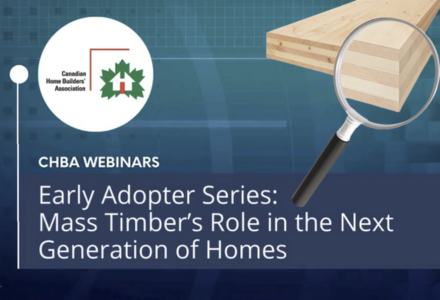
Missed our latest Early Adopter webinar? Here’s what you need to know: Mass timber isn’t just a buzzword—it’s an emerging solution for speed, sustainability, and style. Natasha Jeremic and Rob Jonkman from the Canadian Wood Council, Hailey Quiquero from Woodworks, and Joe Geluch from Naikoon Contracting shared how prefabricated mass timber can reduce build times and embodied carbon while offering a new design flexibility. From 6-storey hybrids to 18-storey towers, real-world projects can show cost parity with concrete when other soft costs are considered, like significant schedule savings. The webinar explored moisture management, fire performance, and even wood foundations for low-carbon homes. Joe Geluch shared insights about early collaboration being critical: “Getting the thinkers and the doers in the room early is essential to optimize design with mass timber and avoid costly changes later.” The takeaway? Mass timber may be ready for prime time – even for some low-rise residential projects – and builders who strive to embrace it may gain a competitive edge. Find the resources, case studies, and tools to get started right in the slide deck. Members can watch the recording and access the slides on CHBA’s website to learn about the WoodWorks guides, calculators, and training. This may just be your chance to lead the next wave of innovation in housing! For more information, please email Alex Bols.
|
2025 Codes Offer More Flexibility for Tiered Energy Efficiency Requirements – What You Need to Know
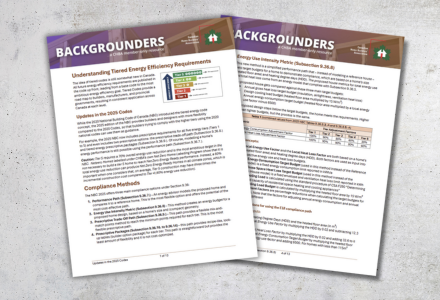
The 2020 National Building Code of Canada (NBC) introduced tiered energy efficiency requirements for homes nationwide ranging from the base code (Tier 1) to the most ambitious energy goals (Tier 5). These national model requirements are now in effect in most provinces and territories. Thanks in large part to CHBA advocacy and technical contributions to their development, the 2025 NBC – expected to be published in a few weeks – will offer more flexibility than the 2020 codes, with prescriptive requirements for all five tiers and new compliance options for small, compact homes. Builders and designers can now choose the prescriptive trade-off “points” path, which allows builders to collect Energy Conservation Points for the Energy Conservation Measures featured in their home until the required points for each tier is reached. The 2025 codes will also offer a prescriptive “package” for tiers 1 and 5, which provides recipe-like tables for envelope and HVAC options. A new Energy Use Intensity compliance path is also being introduced. Airtightness testing will be increasingly critical for reaching higher performance tiers in the 2025 NBC, which attributes airtightness “points” only for homes that are tested. CHBA has prepared an Energy Efficiency Backgrounder in the CHBA Member Knowledge Centre that describes the compliance paths and technical concepts and includes step-by-step instructions and examples, showing how design choices impact compliance. Let us know what you’re seeing and what support you’ll need so we can adapt the backgrounder accordingly. For more information, please email Alex Bols.
|
CHBA Gets Members Ready for Future Codes - Greenhouse Gas Emissions
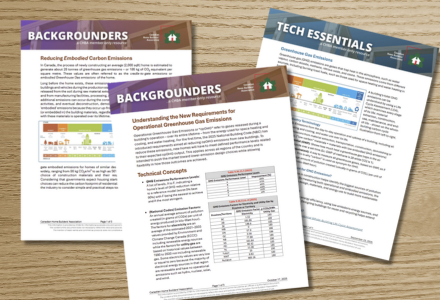
CHBA has been participating in codes and standards meetings and industry forums on how the residential construction industry can reduce greenhouse gas emissions. Although CHBA has significant concerns about how the requirements were developed and approved, we have released two new backgrounders to help members learn the lingo and what future carbon requirements in codes will look like so they can prepare for new codes. The Operational GHG Emissions backgrounder explains the 2025 National Building Code’s first-ever rules for reducing emissions from home operation, covering performance levels, compliance paths, and practical implications for design choices. CHBA will continue to advocate to fix the shortcomings of this code change, but in the meantime, we want to make sure members have as much information as possible. The Embodied Emissions backgrounder looks ahead to potential 2030 NBC requirements on material-related carbon emissions. It outlines what embodied carbon is, why it matters, and how simple material choices can significantly reduce a home’s carbon footprint. It also introduces tools and strategies for estimating and lowering emissions during design and construction.
Are you new to the carbon emissions topic? Explore the CHBA Tech Essential for key terminology that will help you better understand our latest backgrounders and make the most of these resources. For any questions on this topic, please email Bilal El-Zaylaa.
|
Canadian General Standards Board (CGSB) Winding Down
The recently tabled 2025 Federal Budget included an announcement advising that the Government of Canada will “wind down the operations of the Canadian General Standards Board (CGSB).” Furthermore, CGSB’s November 25, 2025 notice advised they’re working on determining next steps in relation to their standards catalogue and services, and developing a transition plan. CHBA staff is involved in the revision of a number of important CGSB standards that impact residential construction, such as radon mitigation, airtightness testing, and glass standards. CHBA will continue monitoring the situation. Once we receive more information, it will be shared with members via our Housing Tech News. In the meantime, if you have any questions, please email Jack Mantyla.
|
Update on Electrical Code – Energy Management System Proposal Kept Alive
CHBA is working with industry partners and decision makers to address a critical cost-saving issue in the Canadian Electrical Code: allowing energy management systems for any load – not just EV charging. While Ontario already amended its electrical Code in Section 8 to allow this, a recent national code proposal to expand the use of Energy Management Systems (EMS) beyond EV charging, which would help avoid costly electrical panel upgrades, was narrowly kept alive after a tied vote. While the subcommittee initially recommended closing the subject, the full committee agreed it needs more review after CHBA pointed out the high cost of unnecessary upgrades. This is an important step because an EMS can allow builders and renovators to manage peak loads without upsizing service, saving thousands of dollars per project. For the next Committee meeting in June 2026, CHBA will push for a coordinated approach that considers all related proposals and product standards, ensuring Canada aligns with international best practices. Our goal is practical solutions that maintain safety while reducing unnecessary costs for homeowners and builders. For more information, please email Frank Lohmann.
|
News Articles
This section includes articles or resources that you might find interesting. They do not necessarily reflect the views or opinions of CHBA.
|
The Canadian Home Builders' Association
141 Laurier Avenue West, Suite 500
Ottawa, ON K1P 5J3
communications@chba.ca
|
|